
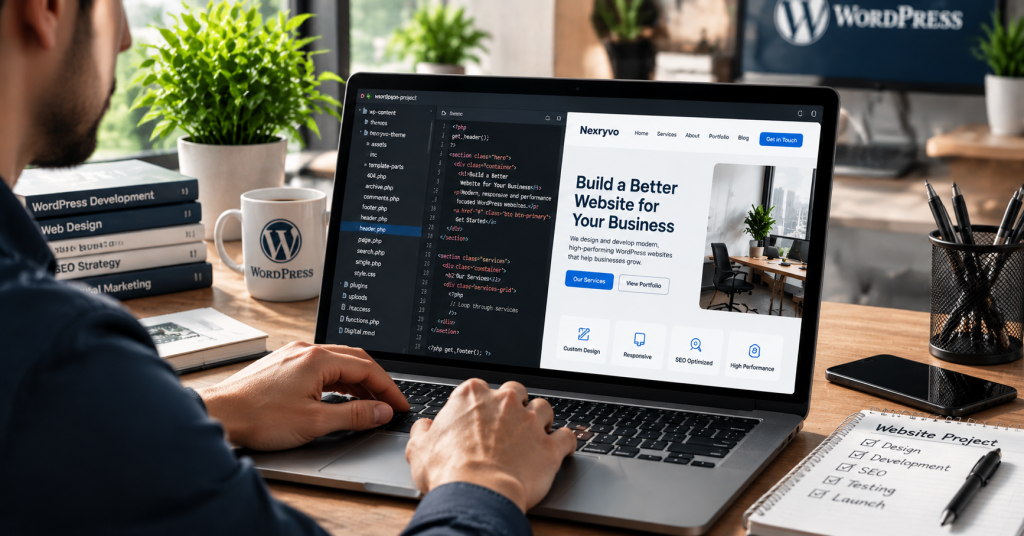
Finding the right WordPress developer can make a significant difference in your business’s online success. A professional website should do more than look attractive. It needs to load quickly, work smoothly across devices, provide a good user experience, and support your business goals.
However, hiring the right developer is not always easy.
Some developers specialize in simple WordPress websites, while others focus on custom development, WooCommerce stores, advanced integrations, and performance optimization. Their pricing, technical abilities, and working processes can also vary considerably.
Choosing someone based only on the lowest price can lead to problems such as poor website performance, limited functionality, security issues, and expensive fixes later.
So, how do you choose the right WordPress developer for your business?
The key is to evaluate their technical skills, previous projects, communication, development process, and ability to understand your requirements.
In this guide, we explain what to look for when hiring a WordPress developer and how to make a confident decision for your next website project.
1. Understand Your Website Requirements Before Hiring
Before you start searching for a developer, identify what you actually need.
Not every business requires the same type of WordPress website. A local service provider may need a simple business website, while an online retailer may require a fully customized WooCommerce store.
Start by identifying your main requirements.
Consider the following questions:
- Do you need a new WordPress website or a redesign?
- How many pages will your website need?
- Do you require custom website design?
- Will you sell products or services online?
- Do you need appointment booking or membership functionality?
- Will your website require CRM or third-party integrations?
- Do you need ongoing maintenance and technical support?
For example, a consulting company may need service pages, appointment booking, lead generation forms, and customer testimonials. An e-commerce business may require product management, payment gateways, inventory tracking, and shipping integrations.
Having a clear project scope helps you find a developer with relevant experience and makes it easier to compare proposals.
2. Check Their WordPress Development Experience
Experience is one of the most important factors when evaluating a WordPress developer.
However, years of experience alone do not tell you everything. You should also understand the types of projects they have completed and whether those projects are similar to yours.
A professional WordPress developer should understand:
- WordPress installation and configuration
- Theme development and customization
- Plugin development and integration
- Responsive website design
- HTML, CSS, and JavaScript
- PHP and WordPress development fundamentals
- Website security practices
- Website performance optimization
- Technical SEO fundamentals
If your project requires more advanced functionality, look for experience with custom post types, WordPress APIs, WooCommerce development, and third-party integrations.
For example, if you need a customized online store, hiring someone who mainly builds basic brochure websites may not be the best decision.
Practical tip: Ask developers about projects they have completed that closely match your website requirements.
3. Review Their Portfolio and Previous Projects
A portfolio provides valuable insight into a developer’s actual work.
Before hiring someone, review several websites they have developed.
Do not focus only on attractive screenshots. Visit the live websites and evaluate how they function.
Look for:
- Professional and consistent design
- Mobile responsiveness
- Clear website navigation
- Fast-loading pages
- Functional contact forms
- Consistent typography and branding
- Proper page structure
- User-friendly layouts
Also, check whether the developer has experience working with businesses in your industry.
For example, if you operate a professional services company, look for previous projects involving consulting firms, agencies, or other service-based businesses.
You can also ask what specific responsibilities the developer handled. Some portfolios showcase websites designed by one person but developed by another.
Understanding their actual contribution helps you evaluate their experience more accurately.
4. Evaluate Their Technical Skills and Development Approach
WordPress development involves more than installing a theme and adding content.
The developer should understand how to build a website that is maintainable, secure, and suitable for your business requirements.
Here are some important technical areas to evaluate.
Theme Development and Customization
Ask whether the developer can customize existing WordPress themes or build custom themes when required.
A good developer should know when to use a pre-built theme, a page builder, or a custom development approach.
Page Builder Experience
Many business websites use visual page builders to simplify design and content management.
Relevant tools include:
- Elementor
- Divi
- Beaver Builder
- Gutenberg
If you already use one of these tools, make sure the developer has practical experience with it.
Plugin Integration
Plugins extend WordPress functionality, but installing too many unnecessary plugins can increase maintenance complexity.
A capable developer should know how to select reliable plugins, configure them correctly, and develop custom functionality when existing solutions are unsuitable.
Performance Optimization
Your developer should understand image optimization, caching, database performance, and unnecessary script reduction.
Ask how they plan to measure and improve website performance.
Security Practices
A professional developer should follow security-conscious development practices, including:
- Keeping WordPress and plugins updated
- Using trusted plugins and themes
- Implementing appropriate user permissions
- Following secure coding practices
- Configuring regular backups
- Protecting administrative access
The goal is not simply to build a website that works today but to create one that can be managed reliably over time.
5. Make Sure They Understand SEO and Website Performance
A website can look excellent and still struggle to attract organic traffic.
That is why choosing a WordPress developer with an understanding of technical SEO and performance is valuable.
A developer does not necessarily need to be an SEO strategist, but they should understand how development decisions affect search visibility.
Important SEO-related considerations include:
- Search-friendly URL structures
- Proper heading hierarchy
- Mobile-friendly layouts
- XML sitemap compatibility
- Canonical URL configuration
- Image optimization and ALT text support
- Website indexing settings
- Structured data implementation when appropriate
- Internal linking support
They should also understand Google’s Core Web Vitals, which measure important aspects of loading performance, responsiveness, and visual stability.
For example, a developer should know that oversized images, unnecessary scripts, and poorly configured plugins can negatively affect website performance.
Practical tip: Ask whether they test websites using Google PageSpeed Insights and how they approach performance improvements.
6. Compare Pricing and Understand What Is Included
Website development pricing can vary depending on project complexity, developer experience, functionality, and the amount of customization required.
A low quote may seem attractive, but it is important to understand exactly what you are paying for.
Before accepting a proposal, ask for a detailed breakdown.
| Development Service | What to Check |
|---|---|
| Website Design | Number of custom page layouts |
| WordPress Development | Features and functionality included |
| Responsive Design | Mobile, tablet, and desktop optimization |
| SEO Setup | Technical SEO configuration |
| Content Upload | Number of pages and content included |
| Performance Optimization | Speed testing and improvements |
| Security | Security configuration and backups |
| Revisions | Number of revision rounds |
| Website Launch | Testing and deployment |
| Maintenance | Ongoing support and updates |
Also, clarify whether the proposal includes hosting, domain registration, premium plugin licenses, and third-party subscription costs.
A professional developer should be able to explain the pricing structure and identify potential additional expenses before the project begins.
Practical tip: Compare proposals based on deliverables and project scope rather than choosing the cheapest developer.
7. Evaluate Communication and Project Management
Technical skills are important, but communication also plays a major role in successful website development.
Your developer should understand your requirements, explain technical decisions clearly, and provide regular project updates.
During the initial discussion, pay attention to whether they:
- Ask questions about your business goals
- Understand your target audience
- Explain technical concepts clearly
- Provide realistic timelines
- Respond professionally
- Share progress updates
- Welcome reasonable feedback
You should also understand how they manage projects.
Ask whether they use project management tools, milestone-based delivery, staging websites, and scheduled review sessions.
For example, a well-organized project may follow these stages:
- Requirement gathering
- Website planning and structure
- Design approval
- WordPress development
- Content integration
- Testing and quality assurance
- Website launch
- Post-launch support
A clear process reduces misunderstandings and helps both parties understand what happens next.
8. Ask About Website Ownership and Post-Launch Support
One important issue businesses sometimes overlook is website ownership.
You should retain appropriate administrative access and control over the website assets you have paid to create.
Before hiring a developer, clarify:
- Who owns the completed website?
- Will you receive administrator access?
- Who controls the hosting account and domain?
- Will you receive the required design and development files?
- Are premium plugin licenses included or separately billed?
- Is documentation provided?
- What happens if you change developers?
Also, discuss post-launch support.
Websites require ongoing maintenance, including software updates, security monitoring, backups, and troubleshooting.
Some developers offer maintenance packages, while others provide support only when requested.
Make sure you understand what happens after the project is completed.
9. Watch Out for Common WordPress Developer Red Flags
Not every developer who promises a professional website will deliver the quality your business needs.
Pay attention to potential warning signs before making a hiring decision.
Unrealistic Promises
Be cautious of developers who guarantee specific Google rankings, perfect performance scores, or immediate business results.
Website performance and search rankings depend on multiple factors beyond development alone.
Unclear Pricing
If a developer cannot explain what is included in the project cost, you may face unexpected expenses later.
No Relevant Portfolio
A developer without verifiable examples of previous work may be difficult to evaluate.
Poor Communication
Repeatedly missing messages, avoiding questions, or providing unclear updates can create problems throughout the project.
No Clear Ownership Agreement
Avoid arrangements where you cannot access your website, hosting account, or essential website assets after completion.
Unnecessary Plugin Dependence
Be cautious if a developer proposes installing multiple plugins without explaining why they are needed.
A professional developer should be able to justify their technical choices.
10. Freelancer vs WordPress Development Agency: Which Should You Choose?
Another important decision is whether to hire an individual freelancer or work with a professional development agency.
Both options can be suitable depending on your project.
| Factor | Freelancer | Development Agency |
|---|---|---|
| Communication | Usually direct | May involve a project manager |
| Pricing | Often more flexible | Depends on team and scope |
| Available Skills | Depends on individual expertise | Access to multiple specialists |
| Project Capacity | Depends on availability | Can support larger projects |
| Design and Development | May handle both | Often handled by separate specialists |
| Ongoing Support | Depends on agreement | May offer structured support |
| Best For | Smaller, clearly defined projects | Projects requiring coordinated services |
When Should You Hire a Freelancer?
A freelancer may be suitable if:
- Your project has a clearly defined scope.
- You need a relatively simple website.
- Your budget is limited.
- You have someone available to manage the project internally.
When Should You Choose an Agency?
A development agency may be more suitable if:
- You need design and development expertise together.
- Your website requires custom functionality.
- You need SEO and performance support.
- Your project involves multiple integrations.
- You prefer an organized development process.
- You need ongoing technical assistance.
The most important factor is not whether you choose a freelancer or an agency. It is whether the team has the right skills, communication process, and experience for your specific project.
Questions to Ask Before Hiring a WordPress Developer
Before making your final decision, ask these questions:
- Can you show me websites you have developed for similar businesses?
- Will my website use a pre-built theme or custom development?
- How will you ensure the website works across mobile devices?
- What steps will you take to optimize website performance?
- Will the website follow basic technical SEO practices?
- How will website security and backups be handled?
- What is included in the project price?
- Who will own the website and its associated assets?
- What is the expected project timeline?
- Do you provide post-launch maintenance and support?
The answers will help you understand the developer’s working approach and whether they are suitable for your business.
Final Thoughts: Choosing the Right WordPress Developer
Choosing the right WordPress developer is an important investment in your business’s digital presence.
The best developer is not necessarily the one with the lowest price or the largest portfolio. You need someone who understands your business requirements, has relevant technical experience, communicates clearly, and can build a website that supports your long-term goals.
Before hiring, define your project scope, review previous work, evaluate technical skills, compare detailed proposals, and clarify website ownership and ongoing support.
Taking the time to evaluate these factors can help you avoid unnecessary development problems and make a more confident hiring decision.
Whether you need a simple business website, a custom WordPress solution, or a fully functional WooCommerce store, choosing the right development partner can help you build a stronger online presence.