
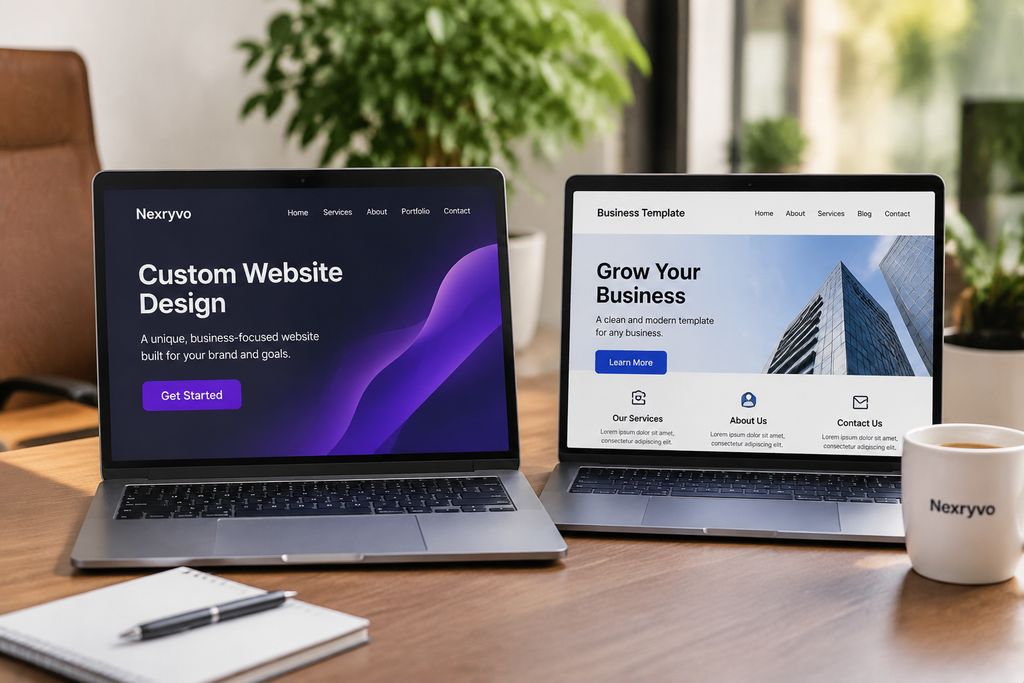
Building a website for your business is a big step. But before you get started, there’s one decision worth thinking about: should you use a ready-made website template or invest in custom website design?
At first, a template might seem like the easier option. You can choose a design you like, add your business information, upload a few images, and get your website online without spending too much.
But things can get a little more complicated when you start thinking about what your business actually needs.
Maybe you want a unique homepage, a particular booking system, or a website that matches your brand perfectly. What happens if the template you’ve chosen doesn’t support those things?
That’s where custom website design starts to make sense.
Of course, that doesn’t mean custom design is always the better choice. Some businesses are perfectly fine with a well-designed template, while others need something more flexible.
So, how do you decide?
Let’s compare custom website design vs website templates, look at their advantages and limitations, and help you figure out which option makes the most sense for your business.
What Is Custom Website Design?
Custom website design means creating a website around your business rather than simply choosing an existing layout and changing a few details.
The design starts with your requirements. That includes your branding, the type of customers you want to reach, the services you offer, and what you want visitors to do when they arrive.
For example, imagine you run a consulting business.
You might need individual service pages, an appointment booking system, a resource section, and a homepage that clearly explains your expertise.
Instead of trying to fit everything into an existing design, a custom website can be planned around those requirements from the beginning.
Depending on the project, custom website design may include:
- Unique page layouts and website structures.
- Colors, fonts, and visual elements that match your brand.
- Custom contact forms and booking systems.
- Additional functionality and third-party integrations.
- Navigation designed around your customers.
- Responsive layouts for smartphones and tablets.
The biggest advantage is flexibility. You’re not limited to what an existing template allows you to change.
However, custom website design usually involves more planning, design work, and development time. It also tends to require a larger initial investment.
It’s worth considering when your business has specific requirements that a standard template can’t comfortably handle.
What Is a Website Template?
A website template is a ready-made design that gives you a starting point for building your website.
It usually comes with pre-designed pages, layouts, fonts, colors, and other design elements. You simply replace the sample content with your own text, images, and business information.
For example, if you’re starting a photography business, you could choose a photography template that already includes a homepage, image gallery, About page, and contact section.
You don’t have to design everything yourself. You just customize the existing layout to make it feel more like your business.
Website templates are commonly available through WordPress themes, website builders, and other website design platforms.
They’re particularly useful for:
- Startups working with a limited budget.
- Small businesses that need a simple website.
- Freelancers and independent professionals.
- Businesses that don’t need complicated features.
- Business owners who want to launch their website relatively quickly.
Of course, templates aren’t perfect.
Some are difficult to customize, while others come with features you may never use. You might also discover that making a particular design change requires additional plugins or development work.
That’s why it’s important to choose a template based on your actual requirements, not just because the demo looks attractive.
Custom Website Design vs Website Templates: What’s the Difference?
Both options can help you build a professional website, but they offer different levels of flexibility and customization.
Here’s a quick comparison.
| Feature | Custom Website Design | Website Templates |
|---|---|---|
| Design | Created around your business | Based on an existing design |
| Initial cost | Generally higher | Generally lower |
| Development time | Usually longer | Often quicker |
| Flexibility | More design freedom | Depends on the template |
| Functionality | Can be tailored to your needs | Uses available features and extensions |
| Branding | Greater control over appearance | Customization may have limitations |
| Future growth | Can be planned around specific requirements | Depends on the theme and platform |
| Maintenance | Depends on the development setup | Depends on the theme, plugins, and platform |
| Best for | Businesses with specific requirements | Businesses needing a simpler starting point |
One thing worth remembering is that a custom website isn’t automatically better, and a template isn’t automatically a compromise.
A properly customized template can work extremely well. Similarly, an expensive custom website can still perform poorly if the design and development aren’t handled properly.
The right choice depends on what your business needs.
5 Things to Consider Before Choosing
Before spending money on website development, take a closer look at these five factors. They can help you avoid choosing an option that doesn’t suit your business.
1. Your Website Budget
Let’s start with something most business owners think about first: the cost.
If you’re launching a new business, you might not have a large budget for website development. You may need to spend money on marketing, products, equipment, or other important parts of your business.
In that situation, a website template can be a sensible starting point.
Much of the design work has already been completed, so you can focus on adding your content, adjusting the layout, and getting the website ready.
Custom website design generally costs more because it involves additional planning, design, and development.
However, don’t make your decision based only on the initial price.
Imagine purchasing a template that looks perfect but doesn’t support the booking system or product layout you need. You might end up paying for extra customization, plugins, or even a complete redesign later.
Think about what you’re getting for your investment and whether the website will support your business as it grows.
2. Design Flexibility and Brand Identity
Your website should feel like part of your business, not something visitors have seen on dozens of other websites.
Templates make it relatively easy to customize basic design elements. You can usually change colors, fonts, images, and certain page layouts.
But what if you want something more specific?
Imagine you own a premium skincare brand. You want a distinctive homepage, carefully arranged product sections, and a shopping experience that reflects the quality of your products.
If your template doesn’t support the layout you have in mind, you may need additional development work.
Custom website design gives you more freedom to make those decisions from the beginning.
You can decide how your pages should look, how your brand should be presented, and how visitors move through your website.
If your visual identity is an important part of your business, that flexibility can be valuable.
3. Website Functionality
Not every business needs complicated website features.
For example, a local cleaning company might only need a homepage, service descriptions, customer reviews, and a contact form.
A good template can handle those requirements without much difficulty.
But what if your business needs something more advanced?
You might require:
- A custom appointment booking system.
- Customer accounts and dashboards.
- Advanced product filtering.
- Membership functionality.
- Third-party software integrations.
- Custom quotation tools.
These features may require additional development.
It’s important to understand that templates aren’t limited to basic websites. Many WordPress themes can support advanced functionality through plugins and integrations.
However, compatibility matters. Before choosing a template, check whether it works with the tools and features you plan to use.
Custom development gives you greater control over how specific features are designed and integrated.
A useful starting point is to write down everything your website needs to do. Separate the features you need right now from those you might want later.
That will make your decision much easier.
4. Website Performance and User Experience
A website can look impressive and still be frustrating to use.
Maybe the pages take too long to load, the navigation is confusing, or the mobile layout doesn’t work properly.
These problems can affect the experience visitors have when browsing your website.
Some templates come with lots of animations, large image sections, and additional features. If they’re not implemented carefully, these elements can affect loading performance.
But custom development isn’t automatically faster either.
Poorly optimized images, unnecessary scripts, and inefficient code can slow down any website, regardless of how it was designed.
What matters is how the website is built and maintained.
Whichever option you choose, pay attention to:
- Mobile-friendly layouts.
- Properly optimized images.
- Easy-to-understand navigation.
- Readable fonts and typography.
- Accessible design elements.
- Fast-loading pages.
- Clear and useful calls to action.
You don’t need a website full of animations to impress visitors. A clean design that works smoothly is often much more useful.
5. Future Growth and Scalability
Your business might look very different a year or two from now.
You could introduce new services, expand into different markets, start selling products online, or add features that weren’t part of your original plan.
Your website should be able to grow with those changes.
A template can work perfectly well for a growing business, provided the theme and platform support the features you need.
However, some templates become difficult to work with when you start requesting major design changes or additional functionality.
Custom website design allows you to plan around your future requirements.
For example, if you know your business will eventually need an advanced booking system or customer portal, you can consider those requirements during the initial planning stage.
You don’t need to build everything immediately. Just make sure the foundation you choose won’t unnecessarily restrict your future plans.
When Should You Choose a Website Template?
A website template is often the better starting point when your requirements are fairly straightforward.
There’s no reason to spend money on a completely custom design if an existing template already provides everything your business needs.
You might prefer a template if:
- You’re launching a new business.
- You have a limited website budget.
- You need a simple business website.
- You don’t require specialized functionality.
- You’re comfortable customizing an existing design.
- You want to get your website online relatively quickly.
For example, a freelance writer might only need a homepage, About page, portfolio, blog, and contact form.
A suitable template can provide all of these without requiring a complicated development process.
The important thing is to choose carefully.
Look for a template that matches your business requirements, works well on mobile devices, receives regular support, and doesn’t come with unnecessary features that could make managing your website more difficult.
When Is Custom Website Design Worth the Investment?
Custom website design becomes a more attractive option when your business needs something beyond what standard templates comfortably provide.
You might consider it if:
- Your business needs a distinctive website design.
- You require custom functionality or integrations.
- Your website supports important business operations.
- You have complex products or service structures.
- You need a specific customer journey.
- You expect your website to expand significantly.
Let’s say you own an established online store.
You might need a particular product presentation, advanced filtering options, customer account features, and connections with other business systems.
A basic template might not offer enough flexibility for everything you want to achieve.
Custom development allows those requirements to guide the project rather than forcing your business to work around an existing layout.
It’s not necessarily about having the most expensive website. It’s about having the right website for the way your business operates.
Can You Get a Custom Website Using WordPress?
Absolutely. WordPress isn’t limited to ready-made themes or standard website layouts.
It offers several ways to build and customize a website depending on your requirements.
You can start with a WordPress theme and customize its pages, colors, typography, and layout. You can also use page builders such as Elementor, Divi, and Beaver Builder to create more tailored page designs.
For example, a business might start with a WordPress theme and customize its homepage, service pages, navigation, and contact sections to better match its brand.
If the project requires more specific features, a developer can create custom layouts, functionality, and integrations.
This makes WordPress a practical option for businesses that want flexibility while still being able to manage their own website content.
The best approach depends on your project.
Sometimes, a customized WordPress theme is all you need. Other times, a more tailored development solution makes sense.
Final Thoughts: Custom Website Design vs Website Templates
So, which should you choose: custom website design or a website template?
It really comes down to your business, your budget, and what you expect your website to do.
If you’re just getting started or need a straightforward online presence, a good website template can be a perfectly sensible choice.
But if your business needs a distinctive design, specialized features, or greater flexibility as it grows, custom website design may be worth the additional investment.
Don’t choose custom development simply because it sounds more professional. And don’t choose a template just because it’s cheaper.
Take some time to understand your requirements before making a decision.
The best website isn’t necessarily the most expensive or complicated one. It’s the one that represents your business properly, works well for your customers, and supports what you’re trying to achieve.
Need Help Choosing the Right Website Design Approach?
Choosing between a website template and custom development can be difficult, especially when you’re not sure what your business will need in the future.
At Nexryvo, we help businesses build professional websites that reflect their brand, meet their requirements, and provide a smooth experience for visitors.
Whether you need a customized WordPress website, a completely custom design, or a redesign of your existing website, we can help you find an approach that makes sense for your project.
Not sure where to start? Visit Nexryvo and get in touch with our team. Let’s discuss your website requirements and find the right solution for your business.