
Starting a business is exciting, but it also comes with plenty of decisions. You need to find customers, promote your services, build a recognizable brand, and make sure people can actually find you online.
One question that comes up sooner or later is whether you really need a website when you already have social media.
After all, creating a Facebook or Instagram business account is free. You can upload photos, share updates, answer customer questions, and promote your products without spending money on website development.
So, is investing in a website really necessary?
The answer depends on your business, but there’s something important to understand: a website and social media do two different jobs.
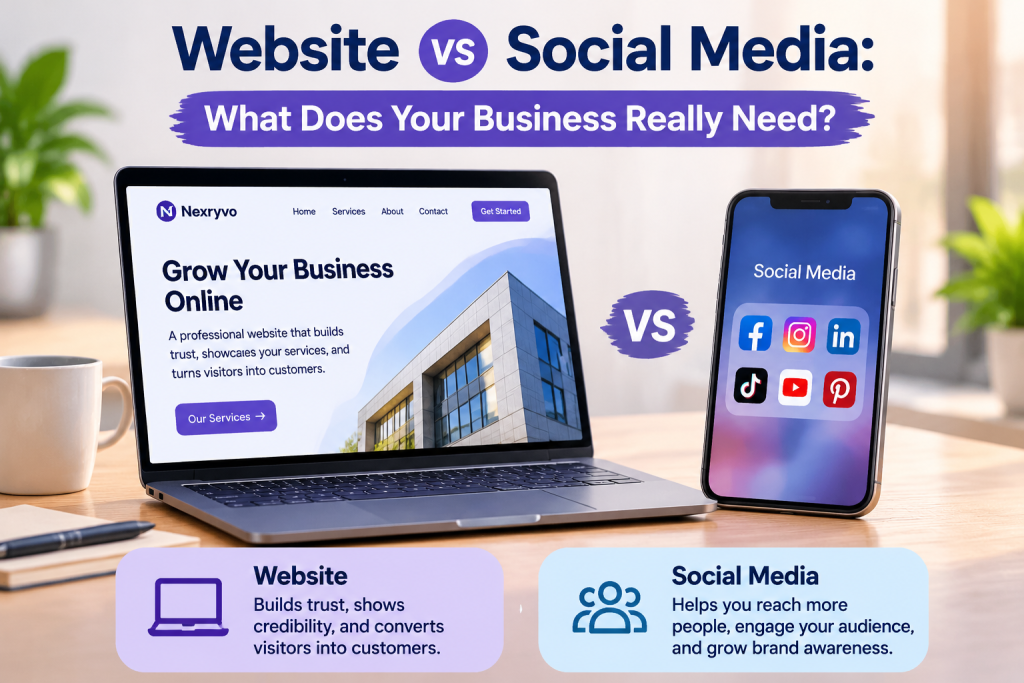
Social media helps people discover your business and interact with your brand. Your website gives those people somewhere to learn more, explore your services, and decide whether they want to work with you.
Both are useful, and knowing how to use them together can make a big difference to your online presence.
Let’s look at what each option offers and how to decide what’s right for your business.
What Is the Difference Between a Website and Social Media?
The easiest way to understand the difference is to think about how customers use each one.
Your business website is your own dedicated space on the internet. It’s where people can learn about your company, browse your services, see your previous work, read useful information, and get in touch.
You decide how the website looks, what information appears on it, and how visitors move from one page to another.
Social media works a little differently. Platforms like Facebook, Instagram, LinkedIn, TikTok, and Pinterest give you a place to share content and connect with people who might be interested in your business.
For example, imagine you own a local bakery.
You could use Instagram to post pictures of freshly baked cakes, share customer photos, announce weekend offers, and show people what happens behind the scenes.
That’s a great way to get attention.
But what happens when someone wants to see your complete menu, check your opening hours, find your location, or place an order for a birthday cake?
A website gives you a much better place to organize all that information.
That’s the main difference. Social media helps you start conversations with potential customers, while your website gives them somewhere to learn more about your business.
Why Having a Business Website Still Matters
Social media is convenient, and there’s no reason to ignore it. However, relying on social media alone can leave some important gaps in your online presence.
Here’s why having your own website is still worth considering.
1. You Have More Control Over Your Business Online
One thing business owners sometimes overlook is that social media platforms don’t actually belong to them.
You can build a following, spend time creating content, and develop relationships with customers, but you’re still working within someone else’s platform.
The platform decides how its features work, what content gets visibility, and which rules users must follow. Those things can change.
A business website gives you much more control over how your brand is presented.
You can choose your domain name, create pages for different services, display your portfolio, publish blog articles, and decide exactly how visitors interact with your business.
For example, a web development agency might want separate pages for WordPress development, custom website design, website maintenance, and WooCommerce development.
Trying to explain all those services through social media posts would quickly become difficult.
A website gives every service its own space and makes it easier for potential customers to find the information they need.
Of course, you’ll still depend on services such as website hosting and domain registration. But your website gives you a dedicated online presence that isn’t limited to a social media profile.
2. People Can Find Your Business Through Google
Imagine someone searching Google for a service your business offers.
Perhaps they’re looking for a local accountant, a website designer, or a company that provides home renovation services.
Wouldn’t it be helpful if your business appeared when they searched?
That’s one of the biggest advantages of having a website.
You can create dedicated service pages, publish helpful articles, answer common customer questions, and optimize your content for relevant search terms.
For example, a plumbing company could create pages about emergency plumbing, water heater repairs, and its service areas.
Someone searching for one of those services might discover the company through Google.
Social media profiles can also appear in search results, but a website gives you more flexibility to create content around the specific things your customers are searching for.
It’s worth remembering that simply launching a website won’t automatically put your business at the top of Google. SEO takes time, and factors such as content quality, competition, technical performance, and website authority all play a role.
Still, if long-term search visibility is one of your goals, having a website gives you somewhere to build that foundation.
3. It Helps Potential Customers Feel More Confident About Your Business
Put yourself in a customer’s position for a moment.
You’ve found a company online and you’re thinking about hiring them. Before making a decision, you probably want to know a little more.
What services do they offer? Do they have relevant experience? Can you see examples of their work? How can you contact them?
A professional website makes it easier to answer these questions.
Depending on your business, you might include:
- A clear introduction to your company.
- Detailed descriptions of your services.
- Examples of previous projects.
- Genuine customer testimonials and reviews.
- Frequently asked questions.
- Contact details and business information.
Let’s say someone is looking for a company to build their business website.
They might discover your agency through an Instagram post, but before spending money, they’ll probably want to explore your services and see examples of your previous work.
A well-organized website makes that process easier and gives them a clearer picture of what you offer.
It’s not about making your business look bigger than it is. It’s about giving potential customers the information they need to make an informed decision.
4. Your Website Can Help Bring in Leads and Sales
A website should do more than look attractive. Ideally, it should make it easier for people to take the next step.
That might mean requesting a quote, booking an appointment, submitting an inquiry, or purchasing a product.
For a service-based business, you could create individual service pages with clear information and a simple contact form.
For an online store, you could use WooCommerce to display products, manage orders, accept payments, and provide a convenient checkout experience.
You can also connect your website to email marketing and analytics tools to understand how visitors interact with your pages.
The important thing is to think about what you want visitors to do.
If someone lands on your website but can’t figure out how to contact you or purchase your products, you’re making things harder than they need to be.
Why Social Media Is Still Important for Your Business
Having a website doesn’t mean you should stop using social media.
In fact, social media can be one of the most useful ways to introduce your business to people who haven’t heard of you before.
Here’s where it really helps.
1. It Helps More People Discover Your Brand
Social media gives you opportunities to reach potential customers without waiting for them to find your website through Google.
You can share product photos, short videos, useful tips, company updates, and promotional content.
For example, a clothing business can use Instagram to showcase new arrivals, style ideas, and customer photos.
A business consultant might use LinkedIn to share professional advice, discuss industry topics, and connect with potential clients.
You can also explore paid advertising if you want to reach specific audiences.
The best part is that you don’t always need a large marketing budget to get started. You can begin by creating useful content and building relationships with people who are interested in what you offer.
2. You Can Talk Directly to Your Customers
Sometimes customers don’t want to fill out a form or send an email just to ask a simple question.
They’d rather leave a comment or send a quick message.
Social media makes that easy.
A restaurant can answer questions about its menu. A clothing store can help someone choose the right size. A service provider can respond to questions about pricing or availability.
These conversations also give you an opportunity to understand your audience better.
You might notice that customers keep asking the same questions or that certain products generate more interest than others.
That information can help you improve your services, create more relevant content, and make better business decisions.
3. You Can Keep Your Audience Updated
Have you launched a new service? Are you offering a seasonal discount? Have you published a helpful article?
Social media makes it easy to share these updates with your audience.
You can also turn existing website content into social media posts.
For example, if you publish an article about choosing the right website platform, you could share a short summary on LinkedIn or create several Instagram posts covering its main points.
This way, you’re not constantly starting from scratch when creating content.
Your website provides the detailed information, while social media helps you share it with more people.
Website vs Social Media: Which One Is Better?
This is where many business owners get stuck.
They assume they need to choose one, but the reality is that both channels serve different purposes.
Here’s a quick comparison.
| Feature | Business Website | Social Media |
|---|---|---|
| Main purpose | Present your business and generate leads | Build awareness and engagement |
| Control | More control over design and content | Depends on platform rules |
| Google visibility | Supports dedicated SEO content | Profiles and posts may appear in search |
| Customer communication | Forms, email, booking, and live chat | Comments and direct messages |
| Design flexibility | Extensive customization | Limited to platform features |
| Content organization | Custom pages and navigation | Feeds and profile sections |
| Online sales | Can support a complete online store | Depends on platform features |
| Long-term content | Organized pages and articles | Visibility depends on the platform |
Neither option is automatically better for every business.
If your main goal is to build an audience and share visual content, social media may be a great starting point.
If customers need detailed information about your services, want to compare providers, or need to purchase directly from you, a website becomes much more valuable.
For many businesses, having both is the most practical approach.
Does Your Small Business Really Need a Website?
Not every business needs a complicated website immediately. What matters is understanding what your customers expect and what you want to achieve.
Let’s look at a few common situations.
If You’re Just Starting Out
When you’re launching a business, your budget may be limited. You might not be ready to invest in a fully developed website, and that’s understandable.
Starting with social media can help you introduce your brand, share your products or services, and see how people respond.
But don’t treat that as the end goal.
As your business starts getting attention, consider building a simple website with your essential information, services, and contact details.
You can always expand it later as your needs change.
If You Run a Service-Based Business
If you offer professional services, a website can be particularly useful.
Think about web developers, consultants, accountants, contractors, and marketing agencies.
Customers usually want to understand what they’re paying for before getting in touch. They may want to review your previous work, compare services, learn about your experience, or understand how your process works.
A website gives you enough room to explain these things properly.
If You Own an Online Store
For an e-commerce business, having a website can make managing your online store much easier.
You can organize products into categories, display product information, manage inventory, offer different payment options, and create a checkout experience that suits your customers.
Social media is still useful for showcasing products and attracting potential buyers.
However, sending interested customers to a dedicated online store gives them a more organized way to browse and purchase.
If Social Media Is Already Bringing You Customers
Perhaps you’ve built a good following on Instagram or Facebook, and people regularly contact you through messages.
That’s great. There’s no reason to stop doing something that’s working.
But ask yourself what happens when a customer wants more information.
Can they see all your services in one place? Can they review your work? Can they find your business details without scrolling through dozens of posts?
If the answer is no, a website could make the customer experience much easier.
You don’t have to replace your existing social media strategy. You can simply give it a stronger foundation.
Why Your Website and Social Media Work Better Together
Rather than thinking about website vs social media as a competition, consider how both channels can support the same customer journey.
Here’s a simple example.
Someone discovers your business through an Instagram post. They like what they see, so they visit your website to learn more.
On your website, they explore your services, check your portfolio, read a few reviews, and decide to contact you.
After becoming a customer, they continue following your social media profiles to stay updated.
That’s how the two channels can complement each other.
You can make this happen in several ways:
- Add your website link to your social media profiles.
- Share your latest blog posts on Facebook and LinkedIn.
- Use Instagram posts to showcase products that link to your online store.
- Share customer feedback and direct interested people to your services page.
- Use social media to announce new website content, services, or offers.
You don’t need to be active on every platform, either.
It’s better to manage one or two relevant social media channels consistently than to create accounts everywhere and struggle to keep them updated.
The goal is to make it easy for people to discover your business, learn about what you offer, and get in touch.
How to Decide Where to Spend Your Marketing Budget
If you’re working with a limited budget, you probably can’t invest heavily in everything at once.
That’s fine. You don’t have to.
Start by thinking about what your business actually needs.
Ask yourself:
- Do customers need detailed information before choosing my services?
- Do I want my business to appear in Google search results?
- Would an online store or booking system help my business?
- Which social media platforms does my target audience actually use?
- Can I regularly create content and respond to customer messages?
Your answers will help you decide where to focus.
For many small businesses, a sensible starting approach looks like this:
Start with a useful website.
You don’t need dozens of pages. A homepage, About page, Services or Products page, and Contact page may be enough to get started.
Choose the right social media platforms.
Think about where your potential customers spend their time. Pick one or two platforms that make sense for your industry and focus on creating useful content.
Connect your website and social media.
Make sure visitors can move easily between your platforms. Share your website content on social media and include clear links to your important pages.
Pay attention to what works.
Look at the number of inquiries, website visits, product sales, and meaningful social media interactions you’re receiving.
Over time, you’ll get a better idea of where your marketing efforts are making a difference.
Final Thoughts: Website vs Social Media – What Does Your Business Really Need?
So, when it comes to website vs social media, which one should you choose?
If you ask us, it’s not really a choice between the two.
Social media helps people discover your business, interact with your brand, and stay updated. Your website gives you a place to present your services, share detailed information, attract search traffic, and turn interested visitors into customers.
You can certainly start a business using social media alone. But as your business grows, having your own website gives you more flexibility and a stronger foundation for your online presence.
You don’t need to build something overly complicated or spend money on features you don’t need.
Start with a website that answers your customers’ questions, makes your services easy to understand, and gives visitors a clear way to contact you. Then use social media to help more people discover it.
That’s a much more practical way to approach your business’s online growth.
Need a Professional Website for Your Business?
At Nexryvo, we believe a good business website should do more than look attractive. It should make a strong first impression, explain what you offer, and give potential customers a reason to get in touch.
Whether you’re starting from scratch, improving an existing website, or planning to launch an online store, we can help you build a website that fits your business needs.
From WordPress website development and custom website design to WooCommerce development and website redesign, Nexryvo provides practical solutions to help businesses build a stronger online presence.
Thinking about building your business website? Visit Nexryvo and get in touch with our team to discuss your project.