
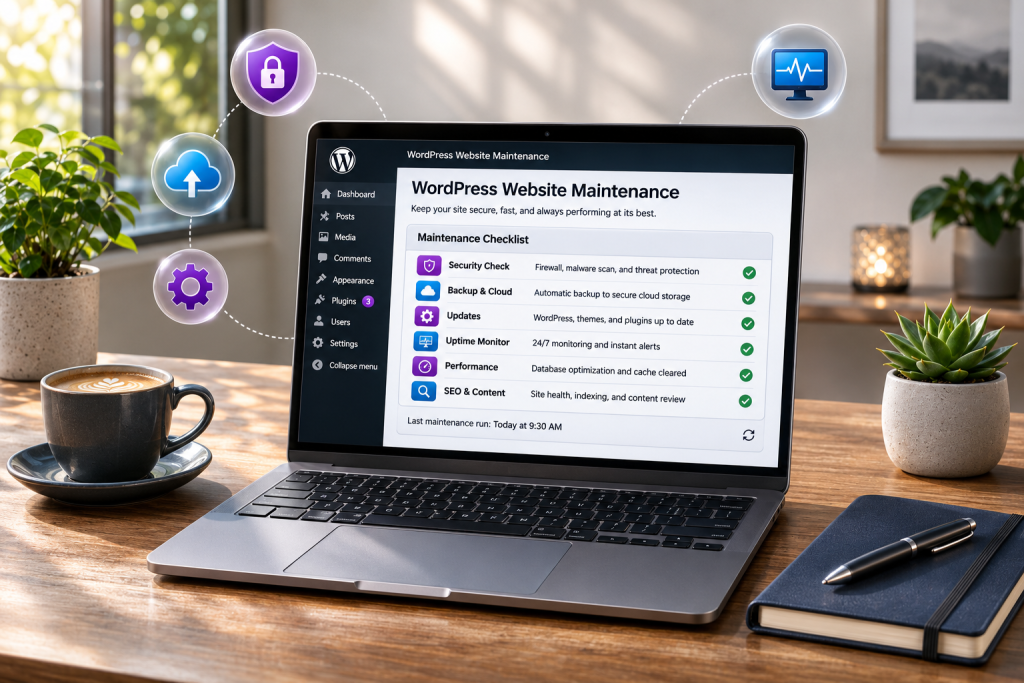
Your website is usually the first real interaction a potential customer has with your business. When it’s slow, outdated, or throwing security warnings, that interaction falls apart. Leads disappear. Trust takes a hit. In the worst cases, the whole site goes down at the wrong moment.
WordPress maintenance is the regular work of keeping the site secure, reasonably fast, and working the way you expect. It’s not a one-time project you finish and forget. Business owners who treat it as ongoing care tend to avoid the expensive emergencies that neglected sites eventually create.
This guide covers the tasks that actually matter, how often they need attention, and when it makes more sense to hand the work off.
Why WordPress Maintenance Matters for Your Business
Most problems don’t come from WordPress itself. They come from the plugins and themes sitting on top of it.
According to Patchstack’s 2026 State of WordPress Security report, 11,334 vulnerabilities were disclosed across the WordPress ecosystem in 2025. Ninety-one percent of them were in plugins. Core itself accounted for only a handful of low-priority issues.
When those plugins stay outdated, known holes stay open. Pair that with missing backups or weak admin practices and you have the usual recipe for a compromised site or a broken one after an update conflict.
Regular maintenance also protects the things that affect revenue:
- Uptime so customers can actually reach you or buy from you
- Performance and technical health so rankings and conversion rates don’t quietly erode
- A clean user experience without broken forms, outdated content, or security warnings
- The ability to recover quickly when something does go wrong
A tested backup turns a disaster into an inconvenience. Everything else just reduces the odds that disaster happens.
Essential WordPress Maintenance Tasks
You don’t need to check the site every day. A simple schedule split by frequency is enough for most businesses.
Weekly Tasks (15–30 minutes)
Check for and install updates to WordPress core, plugins, and themes. Take a full backup first—every time.
Review any uptime alerts from your monitoring tool or host.
Glance at security scan results if you run something like Wordfence or Sucuri.
Clear spam and quickly test key forms or the checkout flow, especially on WooCommerce sites.
Monthly Tasks
Confirm backups are completing and that at least one copy lives somewhere other than the same server as the live site.
Clean the database of old revisions, spam, and expired transients.
Run a quick performance check on important pages and note any Core Web Vitals issues.
Scan for broken links and review Google Search Console for new crawl or indexing errors.
Verify the SSL certificate is still valid and the site forces HTTPS.
Quarterly Tasks
Test a full restore of a recent backup on a staging site so you know the process actually works.
Audit plugins and themes. Remove anything unused or abandoned.
Review user accounts and remove old administrator or editor access.
Check with your host on PHP version support and plan any needed upgrades.
Look through content for outdated information, broken images, or pages that no longer match what you offer.
Practical Tips for Safer WordPress Maintenance
Always back up before updates. A staging environment is ideal for testing bigger plugin or theme updates before they hit the live site. Many hosts make this straightforward.
Limit your plugins. Every extra one increases risk and can slow the site. Prefer well-maintained, widely used plugins and delete the ones you no longer need instead of just deactivating them.
Use strong access controls. Strong passwords, two-factor authentication on every admin account, and limited login attempts block a large number of attacks.
Monitor continuously. Automated uptime and malware monitoring catch problems faster than manual checks. Make sure alerts go to someone who will actually respond.
Document the process. A simple checklist or calendar reminders keep tasks from getting skipped when things get busy.
DIY vs. Professional WordPress Maintenance
Many small business owners handle the weekly checklist themselves with a reliable backup plugin and a security scanner. That works fine for simpler brochure sites.
More complex sites—WooCommerce stores, membership sites, or anything with custom code—usually benefit from professional oversight. Staging tests, careful update sequencing, and fast response to critical vulnerabilities take time and experience most owners don’t have.
Nexryvo provides ongoing Website Maintenance that covers updates, backups, security monitoring, and quick fixes so the site stays healthy without adding another recurring task to your list. We also help with related needs such as Speed Optimization & Technical SEO and full WordPress Website Development when a redesign or new build is the better long-term path.
Conclusion
Consistent WordPress maintenance is one of the higher-return things you can do for a business website. It reduces security risk, protects performance, and stops small issues from turning into expensive emergencies.
Start with the weekly and monthly checklist above. Automate what you can, test your backups, and treat updates as non-negotiable. When the workload or risk grows past what you want to manage yourself, professional support keeps the site reliable while you focus on running the business.